

Gambling websites handle real money. They hold personal data. And they shape high-stakes decisions. That makes them one of the most trust-dependent categories in digital product design.
When a user lands on an unfamiliar gambling site, they need to answer four questions fast:
- Who runs this?
- Is it licensed?
- Where is my money going?
- What happens if something goes wrong?
The answers don’t come from slogans. They come from structure. How information is organized. How licensing details are displayed. How safety tools are placed. And whether the content stays current.
This article treats gambling websites as a UX case study in high-trust design.
Gambling Websites as High-Trust Digital Products
What is a gambling website?
A gambling website is any site that hosts gambling activity — or provides information about it. The term covers a wide range:
| Type | Function |
|---|---|
| Operator site | Hosts casino games, sports betting, or poker with real-money accounts |
| Review hub | Compares operators, publishes evaluations, organizes casino categories |
| Gambling guide | Explains rules, terminology, odds, and strategies |
| Responsible gambling resource | Offers self-assessment tools, help links, and educational content |
| Regulator directory | Lists licensed operators for a specific jurisdiction |
Every one of these sites asks users to trust it — with attention, money, or decisions.
Nielsen Norman Group’s credibility research identifies four factors that make any website trustworthy: design quality, upfront disclosure, comprehensive and current content, and connection to the wider web. Gambling websites depend on all four more than most categories. The cost of misplaced trust here is financial and personal.
What is a gambling platform?
A gambling platform is the technical layer underneath an operator’s website. It manages:
- User accounts and identity verification (KYC)
- Payment processing — deposits, withdrawals, currency handling
- Game catalogues — slots, table games, live dealer feeds
- Odds engines — for sports and event betting
- Compliance tools — deposit limits, session timers, self-exclusion triggers
A gambling website is what the user sees. A gambling platform is what makes it work. Both layers determine whether users feel safe enough to stay.
How Information Architecture Builds User Confidence
A gambling website can list a hundred casinos and still leave users confused. Structure is what separates useful content from noise.
Well-organized resources covering online casinos in Canada group casino reviews, payment categories, legal guidance, and responsible-gaming information into a single navigation system. That kind of structure shows how much information users need before trusting a gambling brand — and it demonstrates how a review hub can organize complexity without forcing users through a single funnel.
What good navigation looks like on gambling sites
Effective gambling websites share several information-design patterns:
| Pattern | Why it matters |
|---|---|
| Separate sections for reviews, payments, legal info, and safety | Users find what they need without guessing |
| Visible update dates on reviews | Shows content is maintained, not abandoned |
| Disclosed review methodology | Lets users evaluate the evaluator |
| Clear labels with no jargon-heavy menus | Reduces cognitive load for first-time visitors |
| Responsible gambling link in primary navigation | Signals safety is a priority, not an afterthought |
| Ad and affiliate disclosure | Builds credibility through honesty about commercial relationships |
When everything is mixed into one page, users can’t tell editorial content from promotional content. Separate categories fix that.
Where review hubs fit into the ecosystem
Review hubs are not operators. They don’t hold deposits, run games, or issue payouts. Their role is to act as information intermediaries. They help users compare claims, spot licensing details, and understand risks before choosing where — or whether — to play.
Key distinction: An operator earns trust by running a fair platform. A review hub earns trust by evaluating operators honestly and disclosing its own methods and commercial relationships.
A review hub is not a guarantee of safety. Users should still verify claims through official sources. That’s where licensing and regulation come in.
Licensing, Regulation, and Legitimacy Signals
What is a gambling license?
A gambling license is formal permission from a regulatory authority to offer gambling services under defined rules. Those rules typically cover:
- Player protection — how disputes are handled and how funds are kept separate
- Game integrity — ensuring outcomes are fair and independently audited
- Responsible gambling safeguards — mandatory tools like deposit limits and self-exclusion
- Anti-money-laundering controls — identity verification and transaction monitoring
Not every jurisdiction applies the same standards. The presence of a license doesn’t automatically mean strong protection. The jurisdiction matters.
Canada: a split regulatory landscape
Canada doesn’t have a single national regulator for online gambling. The framework varies significantly by province — and that matters when you’re trying to verify a site.
Ontario is the only province with an open, competitive online gambling market. Two separate bodies govern it:
- AGCO (Alcohol and Gaming Commission of Ontario) — registers operators and sets the standards they must follow
- iGaming Ontario (iGO) — manages the marketplace through operating agreements with licensed operators
These roles are often confused, even in reputable sources. AGCO is the regulator. iGO is the market manager. Both matter, but for different reasons.
iGaming Ontario publishes a public directory of regulated operators. It’s more reliable than any casino’s own marketing copy. If you’re checking an Ontario-facing site, start there.
Outside Ontario, the model is different. British Columbia (BCLC/PlayNow), Quebec (Loto-Québec/Espacejeux), and the Atlantic provinces run government-controlled monopolies. There’s no competitive market and no equivalent public directory for independent operators. If you’re outside Ontario, check your provincial gaming authority’s website directly.
How do you know if an online casino is legit?
No single check is enough. A practical verification process looks like this:
- Check the regulator’s directory. In Ontario, the iGO directory is more reliable than a casino’s self-reported license number.
- Find the legal entity. A legitimate operator names the company behind the brand — usually in the footer or “About” section.
- Read the terms and conditions. Vague or missing withdrawal terms are a warning sign.
- Look for responsible gambling tools. Licensed operators are required to offer them.
- Test the support channels. Live chat, email, or phone should actually work.
- Cross-reference with multiple sources. One positive review doesn’t establish legitimacy.
If any of these steps hits a dead end, that’s information too.
Scam Avoidance Through Better Interface and Content Design
Scam gambling sites don’t always look obviously fake. Some invest heavily in visual polish while hiding critical information.
Users shouldn’t have to hunt for basic ownership, terms, support, or risk information. If they do, that’s already a red flag.
Red flags to watch for before depositing money
| Red flag | What it signals |
|---|---|
| No licensing details anywhere on the site | Possibly unlicensed or operating in a grey market |
| A headline bonus with no wagering requirements visible | The real cost of the bonus is hidden — the percentage isn’t the issue, the conditions are |
| No responsible gambling link or page | Suggests compliance is not a priority |
| Missing or unnamed legal entity | No accountability if something goes wrong |
| No visible deposit or withdrawal limits | Users can’t control their own spending |
| Broken or fake support links | No real recourse for disputes |
| Aggressive popups pushing immediate deposits | Prioritizes conversion over informed choice |
| No complaint or dispute process | No path to resolution |
How to avoid gambling scams: a practical approach
The strongest protection is verification, not intuition. Concretely:
- Start with the regulator, not the operator. Look up the site in an official directory before trusting its self-reported license number.
- Read withdrawal terms before depositing. If they’re hard to find or full of vague conditions, that tells you something.
- Check the wagering requirements on any bonus. A large match percentage with a high wagering multiplier can cost far more than it appears to offer. Look for that number, not just the headline offer.
- Inspect the responsible gambling section. A real one has tools — limits, self-exclusion, help links. A fake one has a single paragraph and no functionality.
- Compare claims with independent sources. If only the operator itself says it’s trustworthy, that’s not evidence.
- Avoid sites that pressure urgency. “Deposit in the next 10 minutes” is a sales tactic, not a sign of quality.
Responsible Gambling as a UX Requirement
Responsible gambling isn’t a compliance badge to drop into a footer. It’s a core layer of user protection that should be woven into the product itself.
iGaming Ontario frames responsible gambling as playing with less risk of harm — with enough information and tools to make safer decisions. That definition matters. It treats responsibility as a design obligation, not just a personal virtue.
What is responsible gambling?
Responsible gambling means participating in gambling activities with awareness of the risks — and with access to tools that support informed decisions. On a well-designed gambling website, that means:
- Deposit, loss, and session limits users can set themselves
- Plain-language explanations of odds and how games work
- Visible help links to support organizations
- Account controls for cooling-off periods and self-exclusion
- No misleading urgency in marketing or interface copy
Sites that make these tools visible and functional meet the baseline regulatory requirement. That’s the minimum, not a guarantee of genuine care for users. Look at how the tools actually work — not just whether they exist on the page.
What is a gambling self-exclusion?
Self-exclusion is a voluntary commitment to stay away from gambling for a chosen period. The Responsible Gambling Council describes it as a tool that helps someone take a break when they feel they need it.
From a UX perspective, self-exclusion should be:
| Principle | Implementation |
|---|---|
| Easy to find | Linked from account settings and the responsible gambling page, not buried in a FAQ |
| Easy to activate | No lengthy process or discouragement from support staff |
| Clearly explained | Users should know the duration, what it covers, and what happens when it ends |
| Consistent | The tool should work as described, without loopholes |
One important note for Canadian players: Canada has no national self-exclusion program. There’s no equivalent to the UK’s GamStop. Self-exclusion operates at the provincial or individual operator level. In Ontario, each regulated operator must offer their own mechanism — but it won’t automatically apply across other operators. Always check exactly what a specific self-exclusion covers before relying on it.
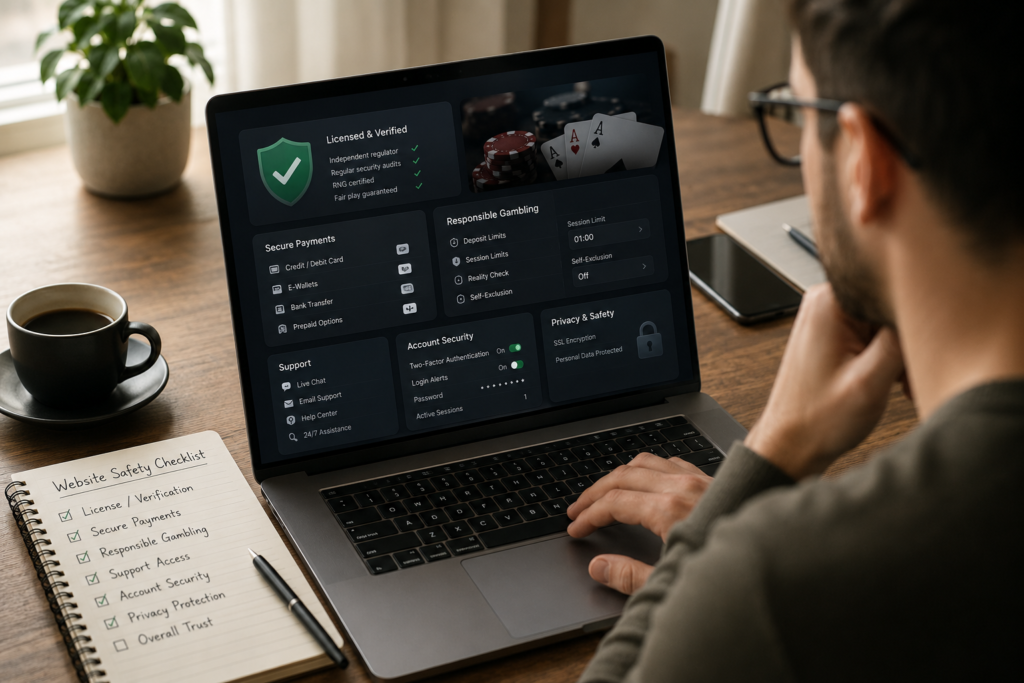
A Practical Trust Checklist for Gambling Websites
Before trusting any gambling website with money or personal data, run through this checklist:
| Check | What to look for |
|---|---|
| Ownership | Named legal entity, physical address, contact details |
| Licensing jurisdiction | Specific license number and issuing authority |
| Regulator verification | Confirmed in an official directory — not just claimed on the site |
| Responsible gambling tools | Deposit limits, session limits, self-exclusion, help links |
| Transparent terms | Clear withdrawal conditions, wagering requirements, fees |
| Current content | Recent update dates, active review cycle |
| Payment clarity | Listed methods (e.g. Interac, Visa, e-wallets), processing times, minimum and maximum withdrawal amounts, currency details |
| Support access | Working live chat, email, or phone — tested, not just listed |
| Review methodology | If it’s a review site: disclosed criteria and evaluation process |
| No pressure tactics | No countdown timers, guilt-based copy, or “last chance” language |
This checklist works best for Ontario-based users, where a public operator directory exists. If you’re in another province, replace the “regulator verification” step with a direct check on your provincial gaming authority’s website — BCLC for BC, Loto-Québec for Quebec, and so on.
How to choose a trusted online casino without relying on hype
The word “trusted” gets used so often in gambling marketing that it has almost lost meaning. Replace “trust” with “verify”:
- Start with an official regulated market directory for your province or jurisdiction.
- Read the operator’s terms and responsible gambling pages before looking at games or bonuses.
- Check whether the review sites you’re reading disclose their methodology and commercial relationships.
- Look for consistent information across multiple independent sources.
- If something feels off, it probably is. Walk away.
Trust in gambling isn’t about finding the right brand. It’s about applying the right questions.
Conclusion
A gambling website’s credibility is not something it can claim in a headline.
It’s built through visible structure: honest information architecture, clear licensing details, functional safety tools, current content, and transparent terms.
For designers and content professionals, gambling sites represent an extreme case of trust-dependent UX. Every pattern that works here — disclosure, clarity, independent verification, user-controlled safety — applies across high-stakes digital products.
For users, the takeaway is simpler: look at what a site shows you before it asks you for anything. The way information is structured tells you more than the way it’s marketed.